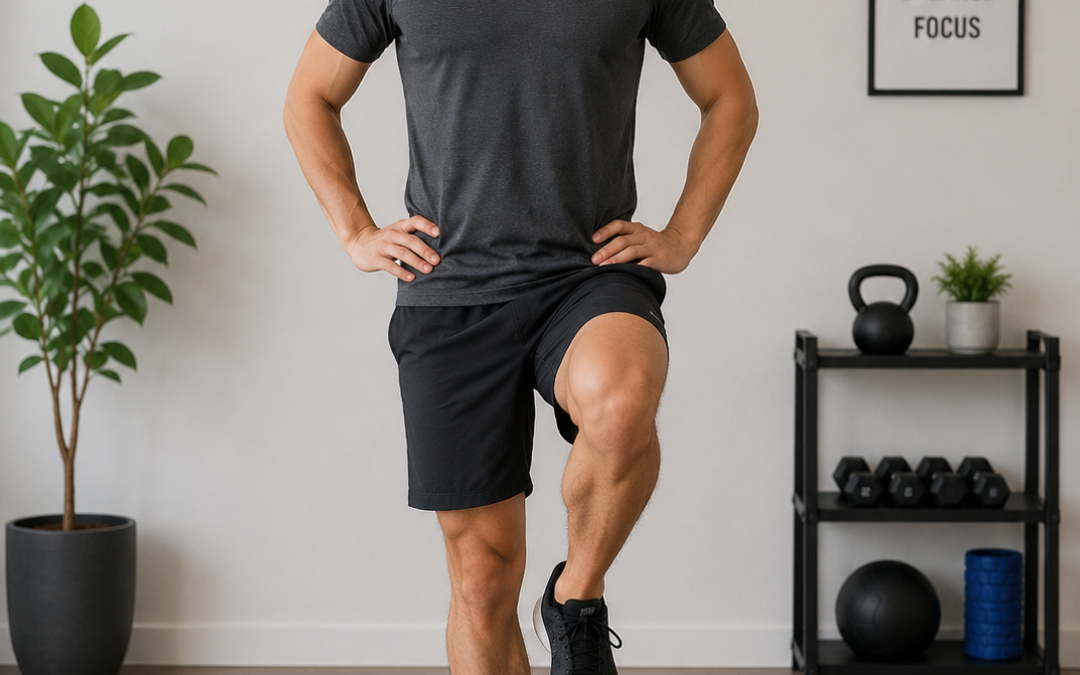
Improving balance and ankle stability is a natural complement to foot strengthening and can reduce the risk of falls, sprains, and chronic joint pain. Below are 5 top balance and ankle stability exercises:
Bonus Guidance:
- Practice 3–4x per week for best results.
- Use barefoot or minimalist footwear to activate more stabilizers.
- Pair these with foot strengthening to build a more resilient lower body.
- Single-Leg Stand (Eyes Open → Eyes Closed)
Purpose: Builds balance and proprioception.
How:
- Stand on one leg with the other slightly off the ground.
- Hold for 30 seconds to 1 minute, then switch legs.
- Progress by closing your eyes or standing on a soft surface (e.g., pillow or foam pad).
Tip: Engage your core and try not to let your hips drop.
- Heel-to-Toe Walk (Tandem Walk)
Purpose: Improves dynamic balance and ankle control.
How:
- Walk in a straight line, placing the heel of one foot directly in front of the toes of the other.
- Keep your arms out for balance.
- Walk 10–20 steps forward and backward.
Tip: Do this slowly and deliberately — imagine walking on a balance beam.
- Lateral Band Walks
Purpose: Strengthens the ankle stabilizers and hip abductors.
How:
- Place a resistance band around your ankles or just above the knees.
- Slightly bend your knees into an athletic stance.
- Take small steps sideways for 10–15 steps in each direction.
Tip: Keep your feet parallel and resist letting them snap back together.
- Standing Calf Raises on an Unstable Surface
Purpose: Strengthens the lower leg while engaging stabilizing muscles.
How:
- Stand on a balance pad, BOSU ball, or folded towel.
- Perform controlled heel raises (lift up onto toes, then lower slowly).
- Do 2 sets of 10–15 reps.
Tip: Use a wall or chair for light support as needed.
- Clock Reach (Star Excursion Balance Test Variation)
Purpose: Challenges dynamic stability and multi-directional ankle control.
How:
- Stand on one leg in the center of an imaginary clock.
- With the other leg, “reach” lightly to different clock positions (e.g., 12, 3, 6, 9).
- Keep the standing knee slightly bent; perform 1–2 rounds per leg.
Tip: Try to reach further over time while maintaining balance and form.